|
|
|

|
... face à
cette fontaine de pierres incandescentes qui déchire
les ténèbres, tout le groupe comprend qu'il
vit là des instants inoubliables..
|
|
|
|
Volcanic rocks
|
|
|
|
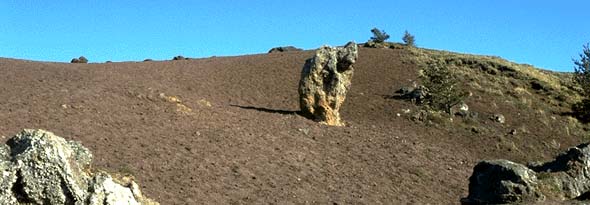
The "Puy de la Vache"
and its "lava Gorilla"
|
Some notions : elements of the Earth crust,
the rocks
|
|
Oxygen, silicon, aluminiun, and so
on...
|
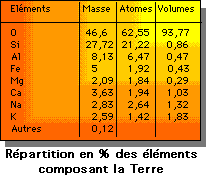
 Eight elements constitute
to 99% the earth's crust. It make major the part
of the rocks in the form of silicates. Chemical arrangements
of these huits elements, of which will depend their mode on
crystallization, will establish an infinite pallet of rocks.
The basalts family accounts
for 95% of the crust, of which they ensure the bases. Eight elements constitute
to 99% the earth's crust. It make major the part
of the rocks in the form of silicates. Chemical arrangements
of these huits elements, of which will depend their mode on
crystallization, will establish an infinite pallet of rocks.
The basalts family accounts
for 95% of the crust, of which they ensure the bases.
Abundance of the elements of
earth's crust GIF
|
|
|
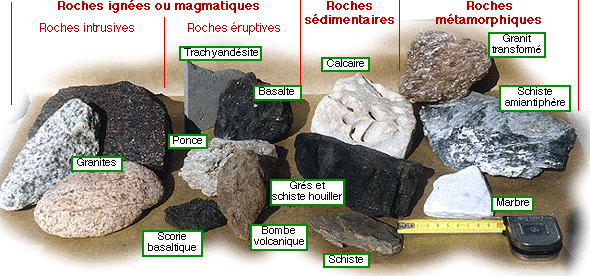
The three principal classes of the rocks
|
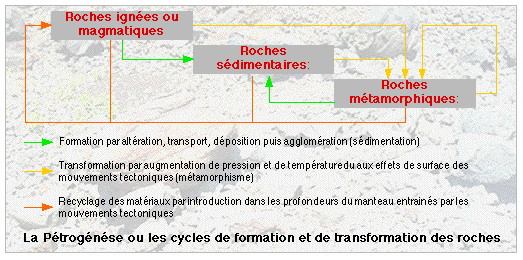
A rock is a mineral agglomeration
formed by crystallization
during their solidification. Petrography (Science
of the rocks) class rocks in 3 families dependent on their process
of formation: the petrogenrating. We distinguishe :
- igneous or magmatic rocks
resulting from the Mantle. We find there naturaly all the volcanic
rocks called eruptive rocks,
and also the intrusive rocks
born from coolings in-depth, without appearance on the surface,
of the magmatic increase (plutonism). The granite forms part
of this last category
- the sedimentary rocks:
they result from degradation, transport, the deposition, all
materials of surface of the lithosphere, follow-up of a physicochemical
transformation which will lead to a more or less thorough agglomeration
of the components.
Two under families define the many recognized formations. It
is the detrital rocks
among which are classified the likings, clays, and the
chemical rocks coming from chemical modifications
in solution (water), or of biological processes (living organisms).
In this last category, one meets there for example limestones,
coals, oils...
- the metamorphic rocks:
in fact there are all the rocks (eruptive, sedimentary or even
already metamorphic) which have undergoes a modification
of structure and texture by increase of pressure
and temperature related on the tectonic movements
of the Earth crust or the contacts with igneous rocks. The schists,
the marbles are metamorphic rocks.
If the metamorphic and sedimentary rocks constitute the majority
of the surface of the continents, the igneous rocks, by their
volume, constitute the bases of them.
|
|
Silica: principal element
|
From the basic elements seen previously the rocks
will be consisted of following chemical
associations : SiO2, ALÒ3, FeiOi, MgO, CaO,
NaÒ, MnO, KÒ, etc. These oxides will join between
them during the cooling of the solution to form while crystallizing,
the minerals of the rocks. The average proportions (in %)
of oxides of all the known rocks are given by the following
table:
|
SiO2
|
AL2O3
|
FeiOi
|
MgO
|
CaO
|
Na2O
|
MnO
|
K2O
|
|
55,2
|
15,3
|
8,6
|
5,2
|
8,8
|
2,9
|
0,2
|
1,9
|
SiO2, the silica, most
abundant, will be the basic element around whose will develop
the silicated minerals.
The latter account for 90% of minerals, the remainder being
metallic oxides, the sulphates,
the chlorides, the carbonates,
etc...
|
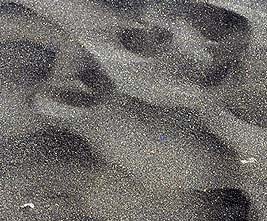
A siliceous element in metamorphic phase:
sand, here a volcanic sand (Stromboli Island)
|
|
|
|
3 principal rocks classes samples
|
From Magma to Lava - The different volcanic
rocks
|
|
The solidification of the magma: the
crystallization of minerals
|
We call magma
materials depths of the Earth crust and the Mantle. In these
zones, the temperatures
(of 650 to 950°C) the high pressures
(several kilobars) contribute directly to the fusion
of materials. The melting point also depends on the
composition of the magmas, in particular the presence of volatile
element such as the gases
(dioxide carbon, hydrogen, chlorine, fluore, sulphur).
In the increase and the
lying of the magmas, the drop temperatures and pressures, the
liberation of gases, cause the solidification of materials,
giving rise to the lava. During these transfers, the minerals
are formed, crystallized and agglomerated.
The rock, thus formed, will present a more or less grained aspect,
(proportion of phenocrysts and microlites), more or less clear
(proportion of silica).
It is by the variation of following minerals and their chemical
composition that is described a volcanic rock:
|
|
|
- the mineralogical composition:
|
|
l'olivine, le quartz, les feldspaths (alcalins et plagioclases),
les feldspathoides, les pyroxènes, les amphiboles,
les micas.
|
|
|
- the chimical composition:
|
|
SiO2, AL2O3, Fe2O3, FeO, MgO, CaO, Na2O, K2O, TiO2 , MnO, P2O5, H2O
|
|
|
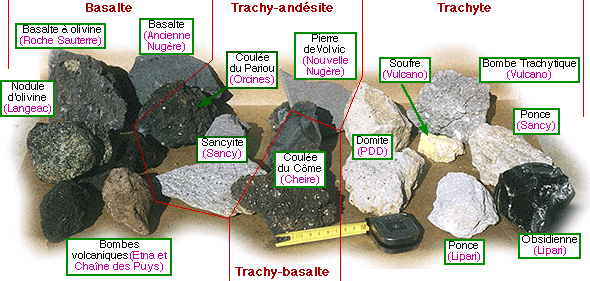
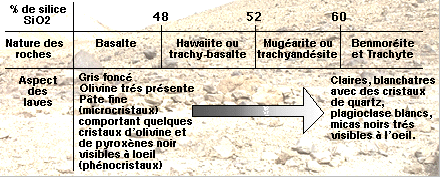
- the classification of the volcanic
rocks: it is the proportion of silica contained in
all the minerals which differentiates names. This proportion
east, let us point out, very significant the bus if it determines,
in addition to the aspect of the rock,
but also the behavior of the volcano
(explosive or effusive), dependent on the fluidity of the magma.
The following table is used as reference:
|
|
|
|
Some volcanic rocks samples according to the
classification
|
|