Puy de Pariou


The star of the Chain

It is a young volcano of about 8,000 years, a period during which this well-known Strombolian cone was formed. This youth explains the freshness of its shapes and makes it a magnificent structure, very visited today. From a volcanological standpoint, it is the result of a complex and turbulent history, whose fallout went far beyond Clermont-Ferrand. Moreover, it is a double-crater system, which does not appear clearly due to the fact that the original structure suffered during the final episodes.

Description

A crater of impressive dimensions


A complex story

This illustrates that this Chain of volcanoes is in constant change, particularly the transformation of the magmas contained in the underlying reservoirs, a transformation that will determine the eruptive dynamism.

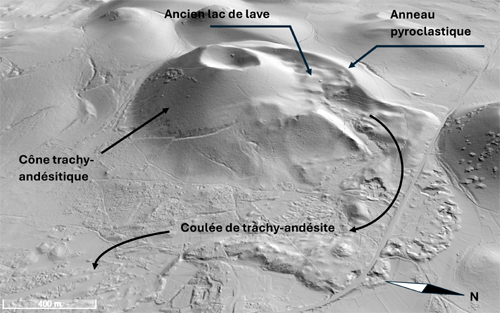
Originally, a few basaltic Strombolian cones of modest height were aligned in the place of the modern Pariou. Then a succession of trachytic explosions from a viscous magma (trachy-andesite) and highly charged with gas tore apart the existing edifices. From this cataclysm, a ring of pyroclastic deposits of trachytic nature was formed.

It was during this phase that the effects were very significant on the neighboring regions, as the resulting pyroclastic flows almost reached the gates of Clermont-Ferrand, and the fallout went much further.

This ring, completed by a crater collapse following any volcanic explosion, will contain a small lava lake fed by the conduits. Under pressure, the northeast edges of the ring will give way, allowing the lava to flow eastward. The outflows will reach Chamalières, Durtol, and Nohanent. This lava, of trachy-andesitic nature, with a composition close to Volvic lava, was once exploited.

The current cone marks the (provisional?) end of the activity prevailing within the trachytic crater.

Système Pariou

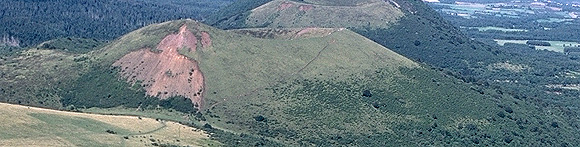
Architecture du système Pariou (vue du puy des Goules)

Description

Mais l'image Lidar d'aujourd'hui est bien plus explicite ! (Source Géoportail)

Description

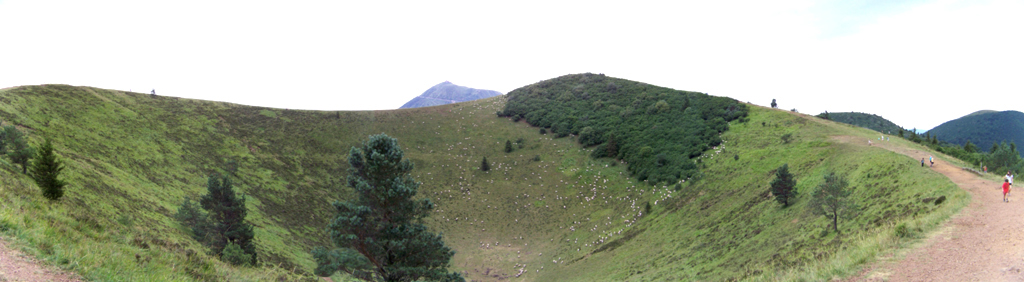
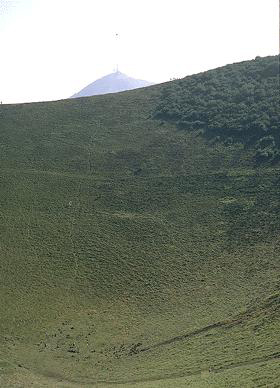
The crater: undoubtedly the deepest in the Chaîne des Puys: 92 meters deep, 300 meters in diameter


Visit

It is called the Auvergne Vesuvius. This reference comes from the fact that it resembles the famous Italian volcano, albeit modestly and only in terms of its morphology – the pyroclastic ring symbolizing the "Somma" and the current cone representing the cone of Vesuvius embedded in the Somma. Like the latter, it is of course very visited. The starting point is at the Col des Goules.

The designated trails leading to the summit reveal the different aspects of the volcano: the pyroclastic ring, the depression of the former "lava lake," and of course the terminal cone.

To preserve the soil and keep the site in good condition, one does not descend into the crater.

As at the summit of all chain volcanoes, the viewpoint is unique. The neighboring volcanoes also offer an interesting view of the Pariou system, notably from the Puy des Goules.

Description


© Copyright Février 2026 Images et Cartes : Bernard Dichamp