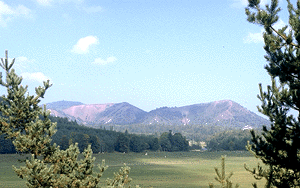
The youngest children in the family
 Their age: about
8,500 years. They are considered to be the most recent
eruptive event of the chain, apart from the Pavin system further
south at the edges of the Cézallier. The south-facing slopes
not covered with vegetation, the sharp edges of the craters,
the steepness of the cones, demonstrate an undeniable
freshness. It seems that they may have 'gone extinct'
just yesterday. These two twins are very frequently visited.
Located near the Col de la Ventouse and the N89 road, they do
not leave anyone indifferent. Combined with their lava flows
spilling from their craters, they perfectly illustrate the typical
volcano found in school and tourist guides. Their age: about
8,500 years. They are considered to be the most recent
eruptive event of the chain, apart from the Pavin system further
south at the edges of the Cézallier. The south-facing slopes
not covered with vegetation, the sharp edges of the craters,
the steepness of the cones, demonstrate an undeniable
freshness. It seems that they may have 'gone extinct'
just yesterday. These two twins are very frequently visited.
Located near the Col de la Ventouse and the N89 road, they do
not leave anyone indifferent. Combined with their lava flows
spilling from their craters, they perfectly illustrate the typical
volcano found in school and tourist guides.
|
|
|
|
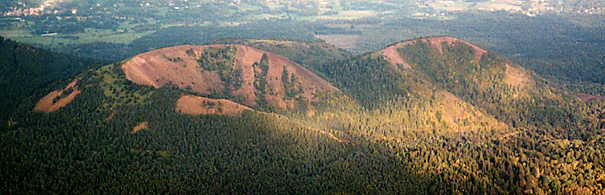
Ombres et lumières
sur les volcans jumeaux
|
|
Eruptive devices
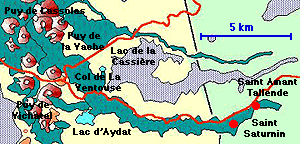
 In fact, it is a single
system with two distinct outlet mouths, which formed
the two cones of Strombolian projections. The basalt lava
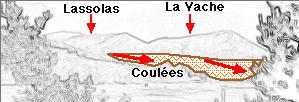
flows, coming from the conduits, after having opened
the cones toward the southwest, then bent eastward by following
the Veyre valley. The steep descent to the lowlands of the Limagne,
along with very fluid lava, produced the longest
flow of the chain: over 15 km up to St Amant Tallende.
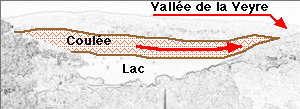
Another particularity of the flows is that they blocked,
in the upper part, the waterways of the Veyre's catchment area,
thereby creating the lakes of Aydat and la Cassière. In fact, it is a single
system with two distinct outlet mouths, which formed
the two cones of Strombolian projections. The basalt lava
flows, coming from the conduits, after having opened
the cones toward the southwest, then bent eastward by following
the Veyre valley. The steep descent to the lowlands of the Limagne,
along with very fluid lava, produced the longest
flow of the chain: over 15 km up to St Amant Tallende.
Another particularity of the flows is that they blocked,
in the upper part, the waterways of the Veyre's catchment area,
thereby creating the lakes of Aydat and la Cassière.
|
|
|
|
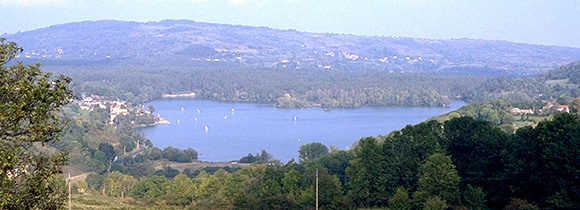
The lac d'Aydat, reservoir
lake formed by the lava flow of the puys de la Vache and de
Lassolas
|
|
Visit
It is possible to
walk around the craters (Attention:
2026 and 2027 will be dedicated to the refurbishment of access
paths and the ascent to the summit). One will observe
the construction of the cones, volcanic
bombs in the center, and
lapilli on the outside. From the summits, a magnificent
view extends over the Massif du Sancy to the south, the Limagne
of Clermont to the west, and the Chain to the north, blocked
by the silhouette of the Puy de Dôme. To the west, the gentle
slope of the plateau supports the wide flows of the surrounding
puys. The Château de Montlosier,
headquarters of the Parc des Volcans, is located at the foot.
A stop is recommended.
The visit to Lake
Aydat will show the appearance of lava flows. These
are very well marked, not
only by vegetation. The Cheires, or
flows, always very chaotic, are not suitable for
cultivation, so people have preferred to plant trees on them.
The lake, shallow, is favorable for swimming and water activities.
A path
connects the craters to the lake, passing through
the lava flows. It winds among the often decametric blocks and
mounds characteristic of 'aa'
lava flows. This is an emblematic volcanic
landscape, similar to those observed on still active
volcanoes. But here, abundant vegetation has since
settled, enveloping the area in a peaceful
atmosphere and remarkable calm.
The descent of the Veyre valley
in the direction of Saint Amant Tallende and Saint Saturnin
is an opportunity to discover the lava
flow. The tour ends in Saint
Saturnin, classified among the 'Most
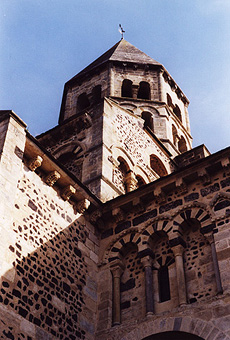
Beautiful Villages of France,' where its 12th-century
church, made of polychrome lava and arkose (feldspathic sandstone),
is built on the end of the flow.
|
|
|
|
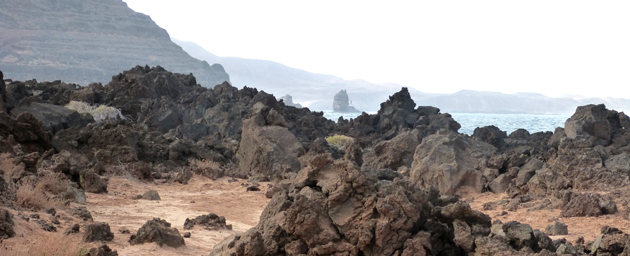
Blocky or "aa" lava flow not covered with
vegetation (Lanzarote, lava flow from La Corona volcano). This
image shows what the flows of the Chaîne des Puys could have
been like during their emplacement and after their cooling
|
|
|
|
Nature of the lavas
A
basalt with 45% silica (SiO2) constitutes the
emitted products. The dark gray of the basalt flows contrasts
with the red color of the cones, yet of the same nature.
The oxidation of bombs,
scoriae, and various lapilli when they were still hot
is responsible for this pinkish
hue, which is also found on most similar structures.
Below:
the extent of the flows of the two volcanoes
Opposite: the
Romanesque church of Saint Saturnin is located on the
flow. The different volcanic materials used
are the origin of the polychrome
architecture characteristic of Auvergne churches,
here combined with the Montpeyroux arkose.
|
|
|