|
A curious phenomenon:
the protrusion needle, a kind of "extruded"
dome
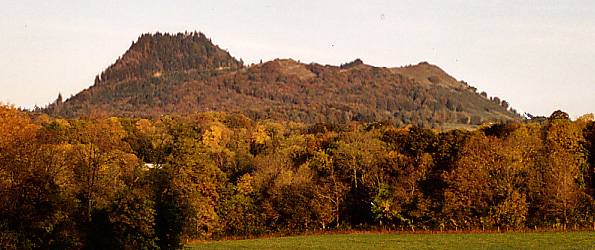
 The Puy Chopine is not the most well-known of the
volcanoes in the Chain. Yet it is easily identifiable. Its unusual
shape catches the traveler's eye. Few structures,
except perhaps the Puys Kilian and Vasset whose elevation was
not as significant, are similar: the
rocky spire that constitutes it was born from the
extrusion of very siliceous magma,
therefore very viscous, and cold
through the crystalline base. A rare and exceptional phenomenon
since the summit rises about 180 meters above the original surface
of the base. Its formation is comparable to the lava spire that
spectacularly appeared in Martinique in 1903, during the eruption
of Mount Pelée. Born just 9,500 years ago, it is among the youngest
volcanoes of the chain. The Puy Chopine is not the most well-known of the
volcanoes in the Chain. Yet it is easily identifiable. Its unusual
shape catches the traveler's eye. Few structures,
except perhaps the Puys Kilian and Vasset whose elevation was
not as significant, are similar: the
rocky spire that constitutes it was born from the
extrusion of very siliceous magma,
therefore very viscous, and cold
through the crystalline base. A rare and exceptional phenomenon
since the summit rises about 180 meters above the original surface
of the base. Its formation is comparable to the lava spire that
spectacularly appeared in Martinique in 1903, during the eruption
of Mount Pelée. Born just 9,500 years ago, it is among the youngest
volcanoes of the chain.
|
|
|
|
L'édifice puy Chopine/puy des Gouttes : un profil qui se remarque
|
|
An explosive building
 |
|
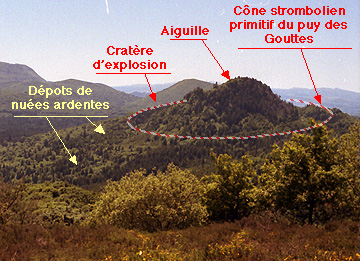
Morphology of puy
Chopine (view from puy de la Coquille)
|
A Strombolian
cone of a size similar to that of the Puy de Côme was originally
in place when a series of trachytic
explosions destroyed most of the structure, leaving
only the southwest portion (which would become the Puy des Gouttes).
This event occurred 9,500 years ago.
An explosion crater (trachytic
maar), the remnants of which can still be seen, was
formed. The activity of such a system is manifested by the emission
of "nuées ardentes"
that will cover the neighboring volcanoes and char the vegetation
of the time. These deposits can reach several meters in thickness
in some places.
If the activity had stopped at
this stage, today there would only remain an explosion crater
several hundred meters in diameter. But magma, probably becoming
increasingly cold and heavily
charged with gas, clogs
the feeding conduit. Under the pressure
of the gases, a block of trachyte, molded by the
conduit, rises. In the process, and by friction, blocks of the
crystalline basement are carried away. A large part of the needle
will collapse as it rises,
but the altitude reached is remarkable. In the end, the entire
crater will be filled by the deposits.
|
|
Visit
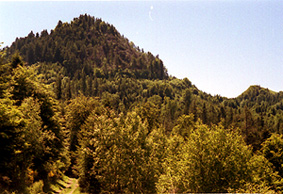 From the "Vulcania"
roundabout, the route that goes around the building allows you
to observe the different aspects of the volcano. A forest access
path leads almost to the summit.
During the ascent—be careful, the path is quite overgrown with
brush—you will observe on the slope the lava of the needle,
a trachyte similar to the domite
of Puy de Dôme with some beautiful biotite crystals. At the
summit, you will notice a section of
the crystalline base, spectacularly reaching this
altitude, about 180 meters higher.
One can imagine the power of the phenomenon. On the way down,
then take the path that runs between Puy des Gouttes and Puy
Chopine. From the "Vulcania"
roundabout, the route that goes around the building allows you
to observe the different aspects of the volcano. A forest access
path leads almost to the summit.
During the ascent—be careful, the path is quite overgrown with
brush—you will observe on the slope the lava of the needle,
a trachyte similar to the domite
of Puy de Dôme with some beautiful biotite crystals. At the
summit, you will notice a section of
the crystalline base, spectacularly reaching this
altitude, about 180 meters higher.
One can imagine the power of the phenomenon. On the way down,
then take the path that runs between Puy des Gouttes and Puy
Chopine.
From this valley, one can better
gauge the height of the needle. Next, a well-marked trail leads
to the southern lip of Puy des Gouttes, where the view of the
neighboring volcanoes is not to be missed. This route, partly
in the undergrowth, is quite rarely used. It gives off a calm
and peaceful atmosphere. A variant leads to the puys
of the Coquille and of the Jumes further to the north.
|
|
|
|
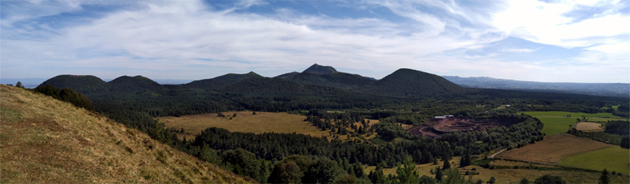
The central part
of the chain seen from the Puy des Gouttes
|
|