|
|
|

|
I would like to
see the inside of this boiler, whose powerful panting
I can already hear..
|
|
|
|
|
The formation of the chain
|
|
|
|
An
exceptional alignment
|
| |
|
Why are there volcanoes in Auvergne?
|
|
|
|
|
Originally: the meeting of Africa and
Europe...
|
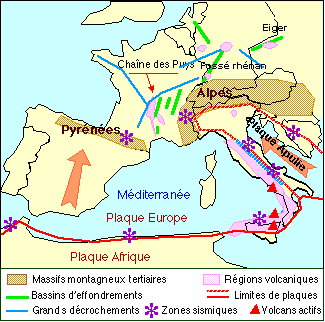  The Tertiary era in Western Europe is marked
by major tectonic upheavals.
Indeed, the uplift of the Apulian
plate, pushed northward by the African plate colliding
with the Eurasian plate, was responsible, during the Cretaceous
and then the Paleocene and Eocene, for the final closure of
the Tethys Ocean, the
Alpine orogeny, and the
opening of the Western Mediterranean
through the rotation of the Corsica-Sardinia block. This activity
is still notable today, as Italy and the Balkans are affected
by powerful earthquakes
and the volcanism of the Italian
peninsula remains very
active (Vesuvius, Phlegraean Fields, Larderello,
etc.), as well as further south, in the Aeolian
Islands and Sicily (Stromboli, Etna). The Alpine
thrust has impacted the whole of Western Europe since the
Eocene, creating lithospheric stretching
that reactivates ancient Hercynian structures. Thus, the sedimentary
basins of Limagnes, Bresse, the Rhine
Graben, and the Eiger form on the Alpine
foreland. This first tectonic phase will be followed
in the Oligocene by volcanism. This structural organization
resembles a form of rifting
(lithospheric extension and volcanism). The Tertiary era in Western Europe is marked
by major tectonic upheavals.
Indeed, the uplift of the Apulian
plate, pushed northward by the African plate colliding
with the Eurasian plate, was responsible, during the Cretaceous
and then the Paleocene and Eocene, for the final closure of
the Tethys Ocean, the
Alpine orogeny, and the
opening of the Western Mediterranean
through the rotation of the Corsica-Sardinia block. This activity
is still notable today, as Italy and the Balkans are affected
by powerful earthquakes
and the volcanism of the Italian
peninsula remains very
active (Vesuvius, Phlegraean Fields, Larderello,
etc.), as well as further south, in the Aeolian
Islands and Sicily (Stromboli, Etna). The Alpine
thrust has impacted the whole of Western Europe since the
Eocene, creating lithospheric stretching
that reactivates ancient Hercynian structures. Thus, the sedimentary
basins of Limagnes, Bresse, the Rhine
Graben, and the Eiger form on the Alpine
foreland. This first tectonic phase will be followed
in the Oligocene by volcanism. This structural organization
resembles a form of rifting
(lithospheric extension and volcanism).
An atypical geodynamic context
|
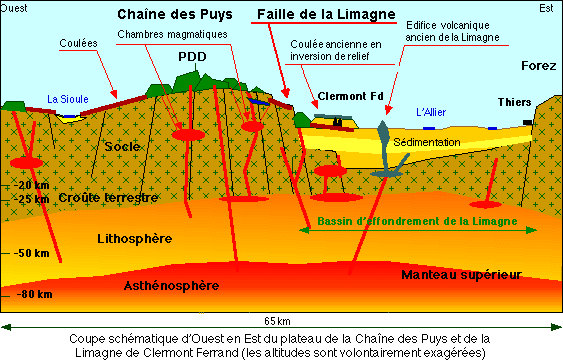
The volcanic complex of the Massif Central,
associated with the tectonic structures of the Limagnes, is
therefore considered a major element of the geodynamics
of Western Europe, belonging to the Alpine foreland.
The volcanism of the Mc is typically classified as intraplate
dispersed continental volcanism. It produces alkaline
magmas from a lherzolitic
mantle with a low melting rate
of about 5%, which concentrates potassium (K) and sodium (Na).
These magmatic liquids form under pressure conditions exceeding
2 GPa, corresponding to a depth of approximately
75 km to 100 km and temperatures
above 1250°C. Their geochemical signature, in terms
of composition, is similar to that of oceanic islands situated
above large mantle plumes, or hot
spots.
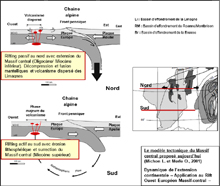 However,
the concept of a hotspot is generally more difficult to apply
in the case of intraplate volcanism in the Massif Central,
due to a number of differences, including the
dispersion of eruptive provinces, the multitude
of plumes, the low volumes of magma
emitted, and so on. This concept was widely debated
by the scientific community until the early 2000s, when an
alternative, more convincing model
involving an initial rifting followed
by mantle convection (asthenospheric flow) was
proposed to explain its formation (Michon L. and Merle O.,
2001). However,
the concept of a hotspot is generally more difficult to apply
in the case of intraplate volcanism in the Massif Central,
due to a number of differences, including the
dispersion of eruptive provinces, the multitude
of plumes, the low volumes of magma
emitted, and so on. This concept was widely debated
by the scientific community until the early 2000s, when an
alternative, more convincing model
involving an initial rifting followed
by mantle convection (asthenospheric flow) was
proposed to explain its formation (Michon L. and Merle O.,
2001).
Indeed, the upwellings from
Italy that were at the origin of the formation of the Alps
disrupt the crust and mantle. This interaction
created, 35 million years ago, an east-west
extension of the lithosphere, which led to the
formation of the collapse basins of the Limagnes. During this
process, magma forms due to decompression
and then rises along weaknesses in the crust. This volcanic
phase developed 25 million years ago. The combination of these
phenomena thus favored the conditions for the formation of
a continental rift affecting
the Massif Central, as well as all the peri-Alpine regions,
including the Rhine Graben and the Eiger further north. Later,
these conditions changed in favor of mantle
upwellings due to thermal imbalances in the mantle
created by lithospheric sinking
beneath the root of the Alps. This phenomenon, which primarily
impacts the southern Massif Central and began 13 million years
ago, erodes the lithosphere, creates a notable uplift
of the southern part of the massif with an intense
volcanic phase.
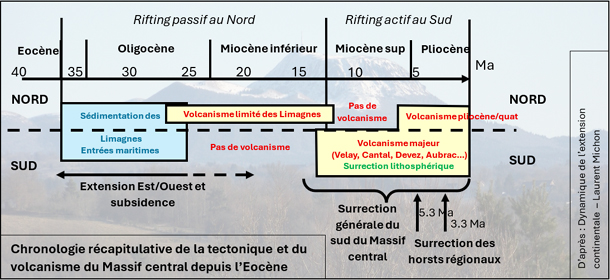
Volcanism in the
Auvergne region began 25 million years ago with
the manifestations in the Limagnes, but the most intense period
occurred later with the formation of the Cantal
(-13 Ma to -3 Ma), the Cézallier
(-6 Ma to -3 Ma), the Mont Dore-Sancy
(-3 Ma to -200,000 years), further southeast the Velay/Devès
complex (-13 Ma to -1 Ma), and the Aubrac
to the south (-7 Ma to -3 Ma) (see
the chronology).
The first volcanoes of the Chaîne
des Puys emerged 100,000
years ago (see
the chronology). The activity has not been continuous
up to the present; rather, it appears intermittent, marked
by phases of maximum intensity and periods of dormancy. Several
major peaks are observed around 90,000, 60,000,
and 30,000 years BP, followed by a final
phase of fairly marked activity between 10,000
and 8,000 years BP. It should also be noted that the duration
of eruptions for each monogenetic edifice likely lasted only
a few months to a few years
at most.
|
|
The Chaîne des Puys: a dominant
alignment
|
 Volcanism in the
Auvergne region began 25 million years ago with
the manifestations in the Limagnes, but the most intense
period occurred later with the formation of the Cantal
(-13 Ma to -3 Ma), the Cézallier
(-6 Ma to -3 Ma), the Mont Dore-Sancy
(-3 Ma to -200,000 years), further southeast the Velay/Devès
complex (-13 Ma to -1 Ma), and the Aubrac
to the south (-7 Ma to -3 Ma) (see
the chronology). Volcanism in the
Auvergne region began 25 million years ago with
the manifestations in the Limagnes, but the most intense
period occurred later with the formation of the Cantal
(-13 Ma to -3 Ma), the Cézallier
(-6 Ma to -3 Ma), the Mont Dore-Sancy
(-3 Ma to -200,000 years), further southeast the Velay/Devès
complex (-13 Ma to -1 Ma), and the Aubrac
to the south (-7 Ma to -3 Ma) (see
the chronology).
The first volcanoes of the
Chaîne des Puys emerged
100,000 years ago (see
the chronology). The activity has not been continuous
up to the present; rather, it appears intermittent, marked
by phases of maximum intensity and periods of dormancy.
Several major peaks
are observed around 90,000, 60,000, and 30,000 years BP,
followed by a final phase of fairly
marked activity between 10,000 and 8,000 years
BP. It should also be noted that the duration of eruptions
for each monogenetic edifice likely lasted only a
few months to a few years at most.
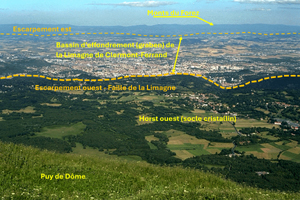
La Limagne vue
du puy de Dôme en direction de Clermont Ferrand
|
|
|
|
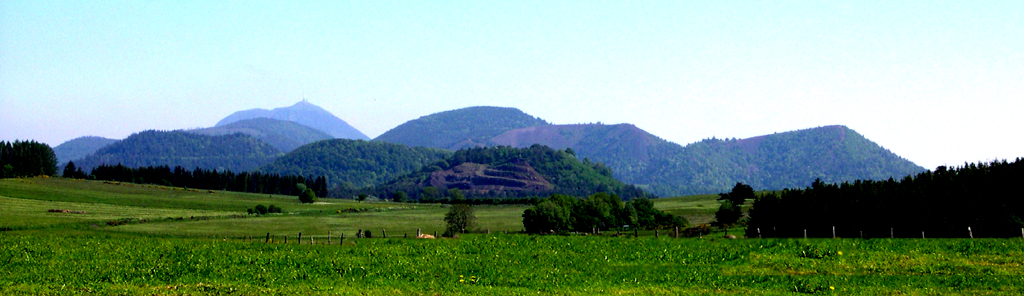
Like the Chaîne des Puys,
the Limagne fault is listed
as a UNESCO World Heritage
site because it represents a unique
and understandable summary of Cenozoic
tectonic dynamics characteristic of the Massif
Central and, more broadly, of Western
Europe.
|
|
The Chaîne des Puys: a remarkable example
of magma evolutions
|
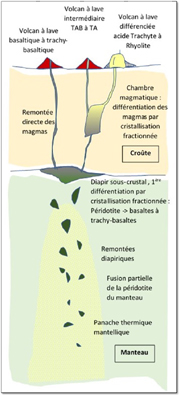 On the page dedicated to igneous rocks,
we saw how magmas form through localized partial
melting of the upper mantle
(lithospheric mantle or asthenospheric mantle). The continental
crust is rarely subject to melting, except in specific
cases (melting of a deep orogenic root, melting due to the effect
of a powerful plume). The rise of liquids
can be direct and rapid,
without encountering obstacles. In this case, material of composition
close to the melting zone reaches the surface, which can be
anhydrous or hydrated peridotite, metasomatized material, etc.,
depending on the geodynamic context.
The emitted lavas are generally basanites
or microlitic textured basalts containing a few phenocrysts
of olivines and pyroxenes immersed in a dark paste, the rock’s
matrix, called mesostasis.
If the cooling is rapid during the eruption, crystallization
is halted. The first minerals formed (phenocrysts)
are then isolated in a groundmass (microlites + glassy matrix). On the page dedicated to igneous rocks,
we saw how magmas form through localized partial
melting of the upper mantle
(lithospheric mantle or asthenospheric mantle). The continental
crust is rarely subject to melting, except in specific
cases (melting of a deep orogenic root, melting due to the effect
of a powerful plume). The rise of liquids
can be direct and rapid,
without encountering obstacles. In this case, material of composition
close to the melting zone reaches the surface, which can be
anhydrous or hydrated peridotite, metasomatized material, etc.,
depending on the geodynamic context.
The emitted lavas are generally basanites
or microlitic textured basalts containing a few phenocrysts
of olivines and pyroxenes immersed in a dark paste, the rock’s
matrix, called mesostasis.
If the cooling is rapid during the eruption, crystallization
is halted. The first minerals formed (phenocrysts)
are then isolated in a groundmass (microlites + glassy matrix).
However, the upward migration
of fluids can be slowed by geological
discontinuities, leading to their trapping in pockets
or cavities resulting from existing
fractures or those caused
by magma pressure. In these reservoirs, also called magma
chambers, the liquids will
cool and transform. Bowen's reaction series teaches
us that calcium-rich plagioclase and olivine crystallize first,
followed by pyroxenes, amphibole, and so on. This phase is called
fractional crystallization.
These denser minerals will accumulate
at the bottom of these storage zones. The residual
liquid will thus have different characteristics from the original
liquid. It will continue its progression with its own
characteristics and reach the surface (or stop along
the way in a possible upper reservoir where the same transformation
will occur). This is differentiation
by fractional crystallization. See next to and below
for the principles.
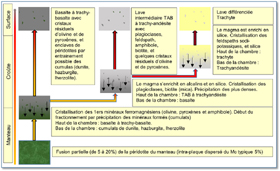 Very schematically, ferromagnesian
minerals, such as olivine, pyroxene, and amphibole,
contribute to the formation of basic
lavas. Calcium is involved in the formation of plagioclase,
and alkalis together with aluminum, in alkali
feldspars throughout the crystallization process.
The latter will be predominant in evolved lavas at the expense
of ferromagnesians. The remaining ferromagnesians
make up the micas (biotites) found in trachytes and rhyolites.
If silica is in excess,
it crystallizes as quartz. If it is consumed early or if the
initial quantity is insufficient,
quartz cannot form. Very schematically, ferromagnesian
minerals, such as olivine, pyroxene, and amphibole,
contribute to the formation of basic
lavas. Calcium is involved in the formation of plagioclase,
and alkalis together with aluminum, in alkali
feldspars throughout the crystallization process.
The latter will be predominant in evolved lavas at the expense
of ferromagnesians. The remaining ferromagnesians
make up the micas (biotites) found in trachytes and rhyolites.
If silica is in excess,
it crystallizes as quartz. If it is consumed early or if the
initial quantity is insufficient,
quartz cannot form.
It should be noted that minerals
stable at high temperatures can become unstable
at low temperatures and go back into solution. This is the case
with olivine with quartz, which transforms
into pyroxene, and amphibole and biotite, which transform into
pyroxene or olivine.
The enrichment
in silica and the decrease in temperature, which affects the
crystal content of acidic lava liquids, are responsible for
their higher viscosity and,
consequently, eruptive dynamics with lava accumulations (domes,
protrusions) that are often explosive.
For example, a trachyte at 800°C can have a viscosity 10,000
times greater than a basalt at 1,200°C. Furthermore, the process
of fractional crystallization concentrates
volatile water and gases, which, combined with the
increase in viscosity, will significantly contribute to the
explosiveness of the eruption.
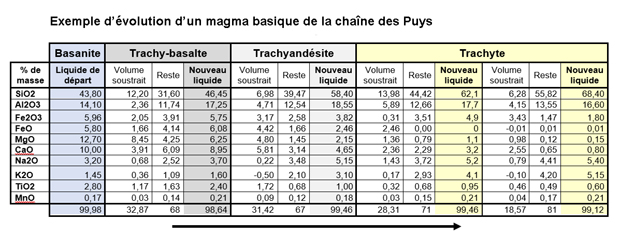
Evolution
of the lavas of the Chaîne des Puys according to their age of
emplacement
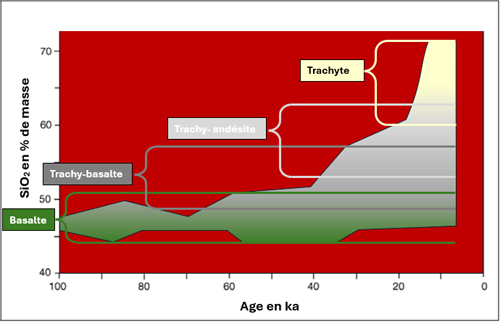
As this diagram shows, the evolution from the
primary basalts of the Chaîne
des Puys lavas lasted less than 100,000
years. The first trachy-basalts
appear very early due to a sub-crustal reservoir where initial
differentiation occurs, then the more evolved trachy-andesites
appear around 40 million years ago, and finally the trachytes
from 13 million years ago onward.
|
|
Evolution of the
magmatic series of the Chaîne des Puys
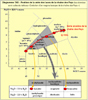 The
magmatic series of the Chaîne des Puys develops within the range
of alkaline lavas (see
TAS diagram), from basic types
(basalts) to more differentiated
types (trachytes).
Thus, over a limited area and within a short period of time
(barely 100 ka), the Chaîne des Puys
stands out for highlighting a magma evolution model of great
interest to volcanology. The
magmatic series of the Chaîne des Puys develops within the range
of alkaline lavas (see
TAS diagram), from basic types
(basalts) to more differentiated
types (trachytes).
Thus, over a limited area and within a short period of time
(barely 100 ka), the Chaîne des Puys
stands out for highlighting a magma evolution model of great
interest to volcanology.
|
|
.jpg)
|
|
West viewpoint of the chain
|
|